

Stained Glass and Artwork in the Courthouse Rotunda
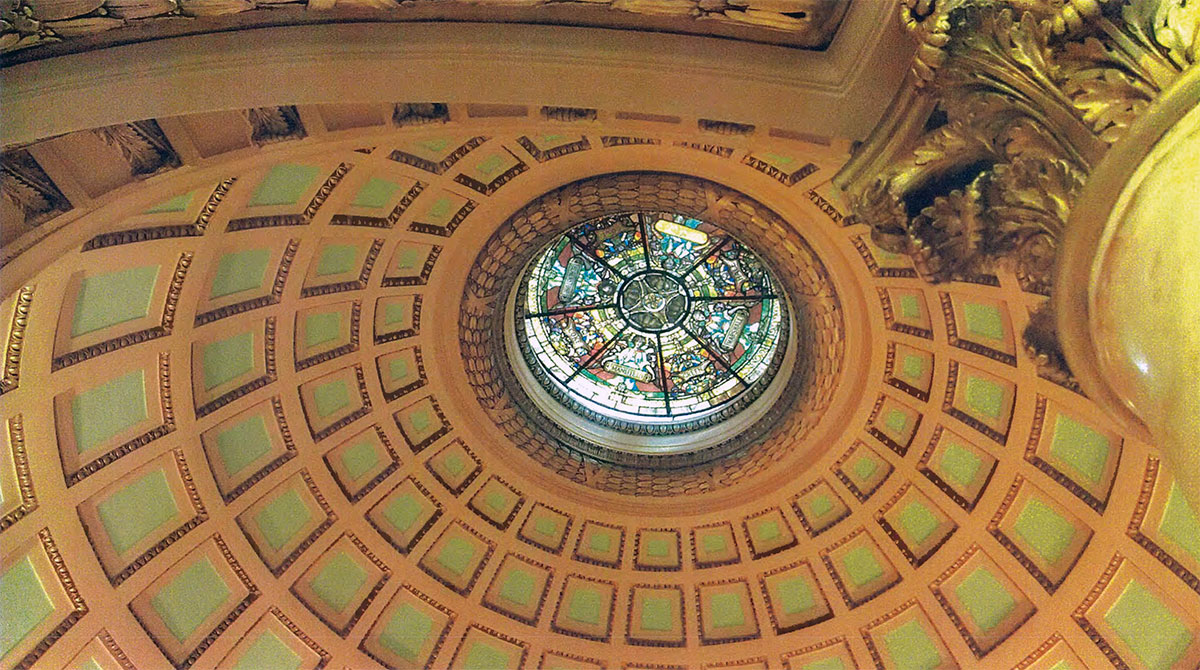
The Courthouse Rotunda was built between 1909 and 1912 in Hackensack. The building has dominated the lower portion of Hackensack along the Hackensack River since it was built.
I recall the first time I saw it as a young teenager. My oldest brother and I took a bus to Hackensack to buy a part to repair his car. As we went on the Bogota Causeway there suddenly appeared this large, impressive building. We walked on Court Street and then the statues, the golden eagles on each of the comer of the building as well as the dome that was in patina green. I was in awe of that building. Little did I then know that I would spend over 40 years of my life trying cases as a lawyer and a judge in this magnificent building. At that time, the Rotunda and jail were separated. In 1958, an addition to the Courthouse connected the two buildings.
The exterior of the Courthouse Rotunda is in of itself impressive. However, inside, almost hidden are wonderful examples of stained glass and other art work. One usually associates stained glass with windows. In the Rotunda, they are not. They are stained glass ceilings. There are six ceilings altogether. There are three in the ceilings of the three main court rooms on the 3rd floor, one on the top of the Rotunda and two on each of the staircases between the 3rd and 4th floor.
These two stained glass ceilings between the 3rd and 4th floor are very beautiful skylights. They are the most overlooked in the courthouse because there is very little pedestrian traffic between the 3rd and 4th floor. The stained glass ceilings cannot be observed standing either on the 3rd and 4th floor, but rather you can only observe their beauty by walking on the staircase. The stained glass ceilings contain two sets of the initials “B.C.” with gold lettering. They have an ornate design with vibrant colors that are highlighted even more by the sunlight that shines through.
In the center of the interior dome of the Rotunda, there is a stained glass skylight eight feet in diameter. The eight panel sections of this have seven names of well known jurists, both British and American. The jurists named are: Blackstone, Cole, Coke, Marshall, Mansfield and Hale. Most are still well known and are well !mown writers on legal matters as well as judges who were very influential in the development of the Common Law. New Jersey is a State that followed the Common Law and cases decided by these people were the law of New Jersey until well into the 20th Century. Blackstone’s Treatise on the Common Law written in the 17th Century were used 100 years later by President Lincoln when he studied the Law.
One American jurist on the Rotunda ceiling is “Marshall.” That is John Marshall, who was the 4th Chief Justice of the United States sitting for 34 years. He played a significant role in the development of the American legal system. There are a number of law schools in America bearing his name. New Jersey had a John Marshall Law School in Jersey City until the 1951. Seton Hall Law School opened that year at the same location in Jersey City.
However, two parts of this panel contain mysteries. There is one that is blank and blocked out. Why that is so, is apparently lost in history. One can wonder if there was a name planned and that person became disgraced or it was left opened for a future name to be added.
Another has the name “Green” on it. There are many accomplished people named Green. However in the legal field, there is none that rises to anywhere near the level of the other names listed. The mystery is who is Green? Obviously, 100 years ago the legal profession of Bergen County thought enough of Mr. Green to put his name next to very prominent legal writers and jurists over the centuries. This panel is located at the very top of the interior of the Rotunda. It is not prominent and does not have lighting behind it, either sun or artificial, that would attract attention to it. While it pays testament to leaders in the development of our law, it is rarely noted by atton1eys or people involved in legal proceedings in the building.
All three of the court rooms on the third floor of the Rotunda have stained glass ceilings. These stained glass ceilings are excellent works of art. These stained glass ceilings are 8 foot by 12 foot comprised of three 4 foot by 8 foot panels in three courtrooms. Courtrooms 352 and 359 have identical ceilings. The center is the Seal of Bergen County. The other two panels are such that their lettering so that the top of each side’s lettering is always towards the Seal in the center panel.
One panel has “JUSTICE” with the scales of justice being held on a sword. The other panel has “PEACE” with Roman fasces which is the symbol for civil authority. These panels contain beautiful colors. They do get natural sun light which makes them very visible in day time. There is a skylight over all these ceiling art work on the third floor. Those skylights protect these works of art and have done so for a century.
The stained glass ceiling in Courtroom 359 is comprised of 3 panels each 4 foot by 8 foot. The center panel is the Seal of Bergen County. The other two panels have both of the lettering of each facing the Seal. One panel has “MOSAIC LAW” written on it and the other panel has “CIVIL LAW” and the word “LEX” (Latin for ”Law”) beneath it.
In the late 19th and early 20th Century there was a strong feeling that the law of Moses basically the Ten Commandments was the starting point of the development of the law. We always think of the Ten Commandments as religious; however, only the first four refer to God or a duty to God. The other six deal with relationships between people including “Honor thy father and thy mother,” “Thou shalt not kill,” “Thou shalt not steal,” “Thou shalt not -bear false witness against thy neighbor,” and “Thou shalt not covet thy neighbor’s house, thou shalt not covey thy neighbor’s wife, nor anything that is thy neighbor’s.” America was more religious in the early 1900’s than now. However, this belief in the relationship of the Ten Commandments to our law is also shown in the murals of Courtroom 352.
These stained glass windows were made by M.J. Lamb. They are still in business as the oldest existing stained glass manufacturer in the United States. They are now located in Wyckoff, New Jersey under the name of Lamb Studios.
In 1979, the Brooklyn Museum was organizing an exhibit called American Renaissance of Late 19th Century Decorative Arts. Stained glass was considered decorative art and the Museum wanted work from some of the skilled but lesser known today stained glass manufacturers of that era. While not as currently famous as John LaForge and Louis Comfort Tiffany, Lamb Studio was famous in the late 19th Century for its stained glass windows, mosaics and murals made for churches, museums, offices and homes. The Museum was seeking examples of Lamb Studios’ work for the exhibit.
Lamb Studios was contacted as to the Rotunda panels of stained glass. Mr. Donald Samick, President of Lamb Studio, examined the stained glass ceilings of the Rotunda. He confirmed that they were his company’s products. He found them to be in very good condition. They have a skylight over the third floor ceiling panels that are still effective. There was no leaking or damage to the panels. These stained glass ceilings have lasted for 100 years now and are prime examples of early 20th Century decorative art. They are still in excellent condition.
In Courtroom 352 are 5 murals which show the advancement of the law. These murals were done by a Teaneck artist, William Winter. Once these murals were approved by the Federal and State Agencies of the W.P.A., the Bergen County Board of Freeholders, and the then presiding Judge of Bergen County Circuit Court, the late Edwin C. Caffrey, they were unveiled at the December Term in 1938. The murals run from left to right. The first is of Moses and the Ten Commandments, which is the oldest written basic law of the western world. The Decalogue in the arms of Moses, commonly known as the Ten Commandments, are the major laws of both spiritual and civil society. The sacrifice of Abraham, which is the foundation of discipline under the law according to the Old Testament, is in the background. The second mural highlights Roman Emperor Justinian, who gave the world the first codification of civil and criminal law. Justinian is shown presiding over a trial in a Roman Court with the Scriba, or clerk, reading the charges: Roman counsels next to the Justice on each sides are considering the points of the arguments. The middle mural shows Christ at the Temple answering learned people there. This was the first recorded public act in the life of Christ. This scene was selected to showcase the peace of the Christian law and the foundation of law in the civilized Western world. The fourth mural depicts King John and the Magna Carta. This scene represents the first development of what would become constitutional law in the United States. The fifth and final mural portrays the birth and foundation of the law of the United States with the signing of the supreme law of the land, the United States Constitution, by New Jersey Representatives William Livingston, David Bready, William Paterson and Jonathan Dayton.
These murals show the same theme as the stained glass ceiling of the Ten Commandments being the starting place of our law. Each mural is a work of art and shows the use of art to teach and instruct.
Courtroom 359 has a mural which is behind and above the Judge’s bench. There are a series of paintings. Each has a Roman motif. Each of these sections are captioned as ”Charity,” “Prudence,” “Law,” “Wisdom,” and “Science.” Under those are words that help to define the meaning. Underneath the first mural is the word “Charity.” Underneath, one could observe the words “Hope, Faith, Protection.” The second mural is captioned with “Prudence” and underneath with the words “Labor, Industries” are present. The middle mural is capti0ned with “Law” and underneath with the words “Order, Jurisprudence.” The fourth mural is captioned with “Wisdom” and underneath with the words “Courage, Integrity.” The fifth and final mural is captioned with “Science” and underneath with the words “Prosperity, Printing.” These words depict some of the cardinal virtues. These various cardinal values are the foundation for what is considered to be a “moral life.”
It is hard to tell when these were done. They appear to be older than the William Winter- murals in Courtroom 352. There are two different versions as to when this mural was done. The Historic Structures Report by Historic Places indicates that “these murals are probably contemporary to the building itself,” which would be 1912. This is not the same as the Wikipedia article on the Bergen County Court House which attributes this mural to William Winter of Teaneck. Appearances of this mural with the ones in Courtroom 253 and 359 would lead one to accept the designation from Historic Registry rather than Wikipedia. These paintings do not have a varnish or other finish. The color on some is fading and their overall appearance has dullness of the paint, which is apparently from aging.
Other murals that are noteworthy for its beauty but also for its historical connection to Bergen County can be found in Courtroom 253. The courtroom is circular in layout. The murals are in a continuing circle of paintings of the earliest homes and structures in Bergen County. One mural depicts the Toll Gate built in 1802. Another shows the Dutch Reform Church, which is still existing, and across the street from the 1819 Court House where the present Court House is. Other murals showcase the Vanderbeck House which was built in 1721, the Mansion House which was built in 1752, and the Jacobus Demarest House which was built in 1681. Existing houses like the Steuben House in River Edge are also shown. It is in reality a catalog of homes and buildings in early Bergen County times.
The Seal of Bergen County as shown on the door knobs were similar to, but different than the current Seal of Bergen County. The seal on the door knobs was adopted by the Board of Freeholders on February 6, 1911 and it is described as:
“Depicting the friendly meeting of the Dutch and Indian, a cartouche representing a Dutch Galley sailing in the sunburst of hope and the National Bird of Freedom.”
There was a drawing by the architect of the Rotunda Courthouse, James Reilly Gordon, which seems to suggest he had a major hand in its design. The major difference between the two Seals is that the attire of both the persons, Dutch and Indian, has changed. In the 1922 Seal, the Indian has a Chiefs bonnet of feather with no upper clothing and a spear in the left hand. The 1923 Seal has the Indian with only two feathers and clothing that goes over his left shoulder and it looks like a peace pipe in the left hand. The Dutch man in the 1911 Seal is wearing a winter coat with a cape while the 1923 Seal has a regular outer jacket.
Of particular interest is the difference in dates. The 1911 Seal has two dates: 1617 and 1910. They_ are part of the outer circle of the Seal that indicates that Bergen County was formed in 1617. The 1910 date represents when the Rotunda work commenced. The 1923 Seal has one date only: 1683, which is between the feet of the two figures of the seal. That would indicate that Bergen County was formed in 1683 and not 1617. ***check exact date
In the Rotunda, there were plans to put the County Seal on each of the door knobs in the buildings. In the Bergen Historic Structure Report in 1993 on the Bergen County Justice Center, there is a footnote #66 which states: “From historic photographs and an examination of the buildings, it is evident that these (seals) were not ordered.”
As an attorney and judge who tried cases from the 1960’s in the Rotunda Courthouse, I saw the door knobs with the County Seal. They were installed in 1912. However, during a renovation in the late 1980’s, they were removed and replaced with stainless steel knobs and locks. A look at the entrance doors to any courtroom shows that a different knob was there before the current ones. The Bergen County Historical Society has a set of these doorknobs in their collection of history of Bergen County. Montvale attorney, Gregory Padovano, obtained a bronze cartouche Seal of Bergen County that was formally on a courtroom door in the Rotunda through E-Bay.
Rumor has it that the bronze seals were distributed to various county officials as paper weights. Older attorneys and Judges, like myself, saw and recall them. The only similar types I ever saw were in City Hall and the Hall of Records in New York City.
At the laying of the Comer Stone of the New Court House on July 6, 1910, William M. Johnson stated in his address that “They (the Courts) are the great safeguards of the freedom of the people, hence we clothe them with dignity and hedge them in by impressive formalities that they may receive the respect and obedience which their exalted prerogatives and powers demand. Hence we build these court houses as temples of justices, substantial, ornate and commodious as the appropriate forum for the great duties which are here to be exercised.” This is something that the Courthouse has undoubtedly lived up to for 100 years .